Published by Horizon Care Services | Companion Care & Senior Wellness
When families think about the risks their aging parents face, they usually picture the physical ones — a fall on the bathroom tile, a missed medication, a health scare with no one home. What far fewer families recognize is that one of the most serious threats to a senior's health is something you can't see on an X-ray and can't fix with a grab bar: loneliness.
Public health researchers have found that lacking social connection carries health risks comparable to smoking up to 15 cigarettes a day. The U.S. Surgeon General considered the problem serious enough to issue a national advisory on the epidemic of loneliness and isolation. For older adults — who are more likely to live alone, lose a spouse, stop driving, and watch their social circles shrink — the risk is not theoretical. It is a daily reality, and it compounds quietly, month after month.
The good news is that this is one of the most solvable problems in senior care. Companion care for seniors exists precisely to close this gap — and for many families across Palm Beach County and South Florida, it turns out to be the single most meaningful change they make for a parent's health, safety, and happiness at home.
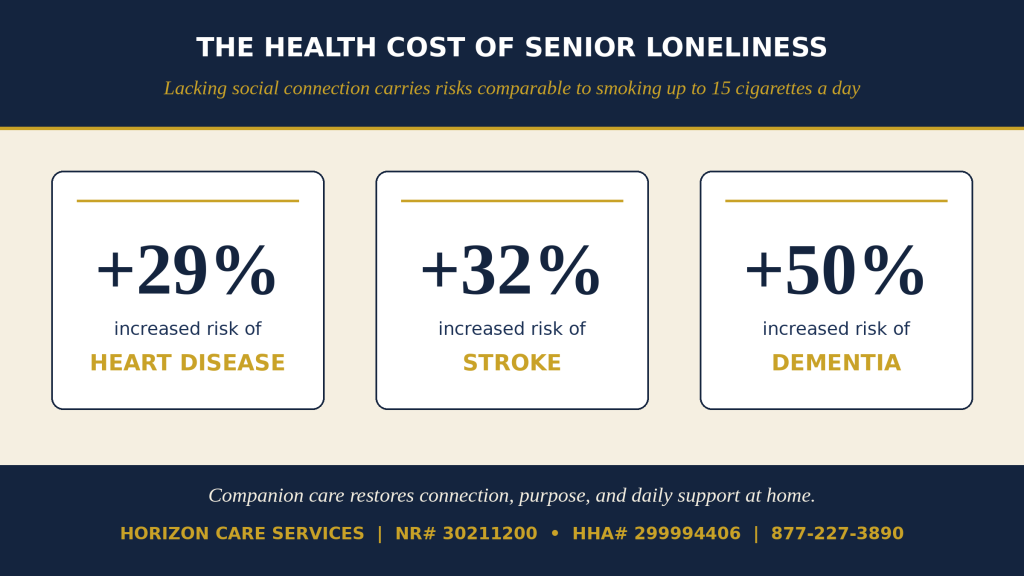
It is tempting to think of loneliness as an emotional issue — sad, but not dangerous. The research says otherwise. Chronic senior isolation has been linked to significantly higher risks of heart disease, stroke, depression, anxiety, and dementia. Socially isolated seniors are hospitalized more often, recover more slowly, and are more likely to experience cognitive decline than their socially connected peers.
The mechanisms are well understood. Isolation raises chronic stress levels, which affects blood pressure and immune function. It reduces physical activity — seniors who are alone simply move less. It removes the informal safety net of another set of eyes: no one notices the skipped meals, the unopened mail, the medication bottle that hasn't moved in a week. And it erodes the sense of purpose and routine that keeps the mind engaged.
In other words, loneliness doesn't just make life smaller. It makes health outcomes worse across the board. That is why addressing it belongs in the same conversation as fall prevention and medication safety — and why companion care has become a core part of modern in-home care rather than a luxury add-on.
Many families hear "companion care" and picture someone sitting quietly in the corner of the living room. The reality is far more active — and far more personal. A trained companion caregiver builds a genuine relationship with a senior around the rhythms of their real life. On any given visit, that might include:
Every one of these activities does double duty. It accomplishes a practical task, and it delivers human connection at the same time. That combination is what makes companion care for seniors so effective against isolation — connection isn't scheduled as a separate activity; it's woven into everyday life. You can see the full scope of what's included on our companion care for seniors service page.
Few life events isolate a senior as suddenly and completely as the death of a spouse. Overnight, the person they shared every meal, errand, and evening with is gone. Adult children often live out of state or are stretched thin with careers and kids of their own. The phone rings less. The days lose their structure. Grief and loneliness begin reinforcing each other.
This is one of the most common — and most important — moments when families reach out for companion care. A companion caregiver cannot replace a spouse, and doesn't try to. What they restore is the daily texture of companionship: someone to talk to over breakfast, someone who knows the stories behind the photographs, someone who makes the house feel occupied again. Families consistently tell us that the change they notice first isn't practical — it's that Mom or Dad sounds like themselves again on the phone.
Grief also carries physical risks for older adults: disrupted sleep, poor nutrition, skipped medications, and withdrawal from activity. A consistent caregiver gently counteracts all of it, while giving family members peace of mind that someone caring is present during the hardest season of their parent's life.
The second great trigger of senior isolation is the loss of driving privileges. In a region like Palm Beach County — where daily life is built around the car — losing the ability to drive can shrink a senior's world to the four walls of their home almost instantly. The hairdresser, the golf course, the card game, the grandkids' recitals, even the doctor's office all become dependent on someone else's schedule.
Many seniors respond by simply asking for less. They skip the outing rather than "be a burden." Within months, a formerly active person is spending nearly every day alone.
A companion caregiver reverses this quietly and completely. Transportation and errand support means the senior's calendar belongs to them again — appointments kept, groceries chosen personally rather than delivered, social commitments honored. The loss of a driver's license stops meaning the loss of a life. This kind of restored mobility is also one of the most underrated ways home care protects long-term independence, a connection we explore in our article on how home care helps seniors stay independent.
One of the biggest misconceptions about in-home care is that it's all-or-nothing — that bringing in a caregiver means committing to full-time help. In reality, most families begin with just a few hours, two or three days a week.
A typical starting arrangement looks like this: a caregiver visits Monday, Wednesday, and Friday for three or four hours. One visit centers on errands and a grocery run. Another includes lunch together and light housekeeping. The third might be built around a standing appointment or simply an afternoon of good company. That modest schedule is often enough to transform a senior's week — every day either includes a visit or anticipates one.
Starting small has two other advantages. First, it gives the senior and caregiver time to build genuine trust and rapport — and at Horizon Care Services, we intentionally match caregivers and clients by personality and shared interests so those relationships form naturally. Second, it means support can grow smoothly if needs change. Because companion care is flexible and hourly home care scales easily, a family can add hours, add personal care assistance, or add specialized support — such as dementia and Alzheimer's care — without ever changing agencies or losing the caregiver their loved one already knows and trusts.
Families often ask how to know when companion care for seniors is worth exploring. These are the signs we hear about most often:
None of these signs means a senior can no longer live at home. In most cases, they mean the opposite — that with the right support, home remains exactly where they can thrive. And because isolation and inactivity also increase physical risks, companionship delivers safety benefits too, something we covered in depth in our article on companion care and reducing fall risks.
For many families, companion care is the entry point into a broader, coordinated approach to helping a loved one age well at home. At Horizon Care Services, companion caregivers work alongside personal care aides, licensed nurses, home therapy providers, and care coordinators under our coordinated services model — so as needs evolve, the plan evolves with them.
And for families who aren't sure where to begin, our senior advocate services provide a knowledgeable starting point: a comprehensive look at your loved one's current situation and an honest recommendation about what kind of support — and how much — would genuinely help.
Horizon Care Services (NR# 30211200, HHA# 299994406) has provided licensed, private duty in-home care to South Florida families for more than two decades. Our companion caregivers serve seniors throughout Palm Beach County — including Palm Beach Gardens, Jupiter, West Palm Beach, Boca Raton, Delray Beach, Wellington, and Tequesta — as well as Martin and St. Lucie Counties.
Loneliness is a health risk. It is also one of the most fixable problems your family will ever face. If someone you love is spending too many days alone, the first step is a conversation. Call Horizon Care Services today at 561-776-7757 (toll-free 877-227-3890) or book a consultation online, and let us match your loved one with a companion who brings connection, purpose, and joy back into everyday life at home.
The material contained on this site is for informational purposes only and DOES NOT CONSTITUTE THE PROVIDING OF MEDICAL ADVICE, and is not intended to be a substitute for independent professional medical judgment, advice, diagnosis, or treatment. Always seek the advice of your physician or other qualified healthcare providers with any questions or concerns you may have regarding your health.
Kindly take a moment to complete the form and a member of our team will reach out to you as soon as possible.
If you're currently experiencing an emergency situation, it would be best to call 911.
Kindly take a moment to complete the form and a member of our team will reach out to you as soon as possible.
No long-term contract · No membership fees · Cancel anytime
If you're currently experiencing an emergency situation, it would be best to call 911.

