The call usually comes at the worst possible time. Your mother fell in the kitchen. Your father woke up confused and short of breath. Paramedics are in the living room asking questions — What medications does he take? Is he allergic to anything? Who is his cardiologist? Does she have a DNR? — and the person who knows the answers is the one who can't give them right now.
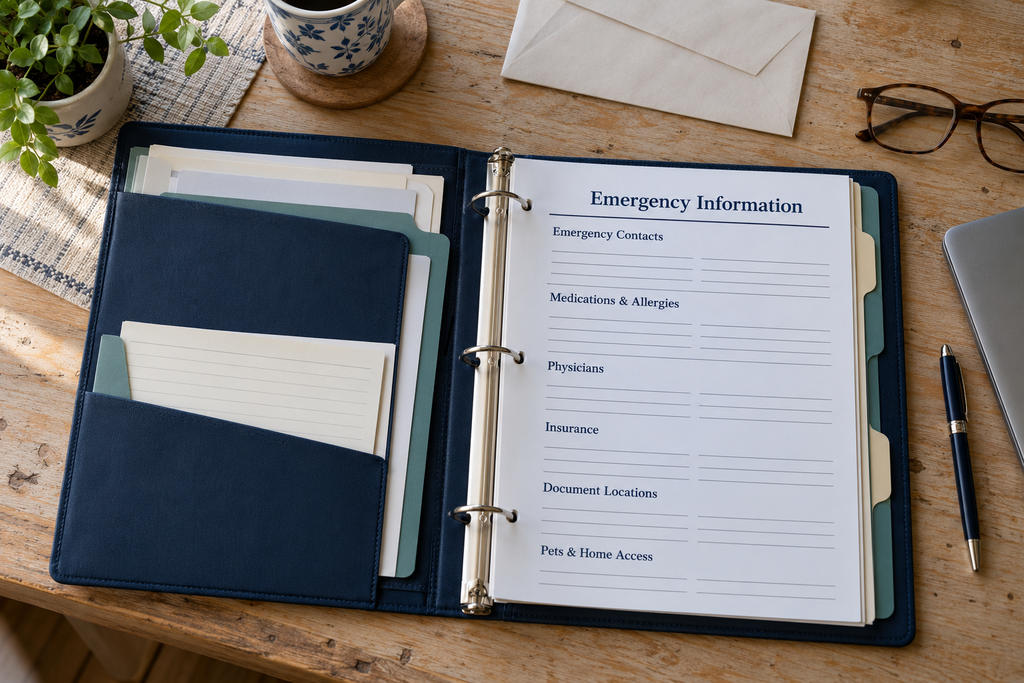
After more than 22 years of caring for seniors across Palm Beach, Martin, and St. Lucie Counties, we have seen how much difference one organized folder makes in those first minutes. This emergency information checklist for seniors walks you through building that folder step by step: a paper version responders can grab, a secure digital copy family can reach from anywhere, and a simple routine to keep both current.
In an emergency, older adults are often the least able to speak for themselves. Pain, shock, a stroke, low blood sugar, or dementia can all make it hard to recall a medication list or a doctor's name. Adult children who live out of town may not know the details, and a spouse under stress can forget things they know well.
A complete senior emergency information folder solves that problem by putting the answers in one predictable place. It helps:
Most families never think about it until something goes wrong. The goal is to spend one afternoon now so that no one is digging through drawers at 2 a.m.
Use the sections below as your working emergency information checklist for seniors. Keep each section on its own page so it is easy to update without rewriting everything.
If keeping this list accurate is already a struggle, our guide to medication management for seniors covers practical ways families stay on top of it.
In most cases, list where legal originals are kept rather than putting originals in the folder. Note the location and who has copies of:
One exception: a Florida Do Not Resuscitate Order (DNRO). The Florida Department of Health requires the official form printed on yellow paper and advises keeping it somewhere easy to see, such as on the refrigerator or at the head or foot of the bed. If your loved one has a DNRO, keep it with — or right next to — the paper folder.
Keep in mind that paramedics generally transport to the closest appropriate facility, especially for strokes, heart attacks, and trauma. A stated preference still helps family and doctors coordinate once the senior is stable.
Door codes, lockbox codes, and alarm codes should not be written in the paper folder. Share them only with trusted contacts — more on privacy below.
A digital version lets an adult child in another state answer a hospital's questions or send a medication list to a new doctor in minutes. Keep it simple and secure:
A folder on the refrigerator can be seen by anyone who walks into the kitchen — visitors, contractors, delivery drivers. Good emergency preparation should not create a new risk. Keep these out of the paper folder entirely:
Current Medicare cards use a Medicare Beneficiary Identifier rather than a Social Security number, so a copy of the Medicare card is appropriate to include. If an older card still shows a Social Security number, contact Medicare for a replacement. Sensitive financial details belong with the durable power of attorney or elder law attorney, not in the emergency folder.
An out-of-date folder can be worse than none, because a responder may trust a medication list that changed months ago. Build in two kinds of updates:
Pick four dates a year — for example, the first week of January, April, July, and October — and put them on the calendar. At each review, confirm the medication list against the pill bottles, check phone numbers, and re-date each page. With Medicare Annual Enrollment running October 15 through December 7, the October review is a natural time to confirm insurance cards, too. In South Florida, pair the spring review with hurricane season prep for seniors so the folder travels with the storm plan.
The weeks right after a hospital stay are when medication lists change most. Our article on post-hospital home care recovery explains what families should watch for during that window.
Even the best-organized family can fall behind, especially when adult children live out of town. That is where a professional care team helps:
For homebound seniors, our sister company Horizon Mobile Physicians provides physician house calls, and the physician's contact information belongs in the folder's care-team section.
The refrigerator door and the inside of the front door are the most common locations, because responders know to look there. Wherever you choose, tell every emergency contact and caregiver where it is.
Generally, list where the original is kept and who holds copies. Ask your elder law attorney whether a copy of the Designation of Health Care Surrogate should be in the folder. A Florida DNRO is the main document that should be kept visible at home.
Most families can complete a first version in one to two hours using this emergency information checklist for seniors. Quarterly updates usually take fifteen minutes.
Horizon Care Services has helped South Florida families care for aging loved ones at home for more than 22 years. Whether you need a caregiver a few hours a week or around-the-clock support, our team can help you put a plan in place — including an emergency folder everyone can trust.
Call 877-227-3890 (local 561-776-7757) or contact Horizon Care Services to schedule a consultation.
Proudly serving: Palm Beach County — North Palm Beach, Palm Beach Gardens, Jupiter, Tequesta, West Palm Beach, Wellington, Royal Palm Beach, Lake Worth, Boynton Beach, Delray Beach, Boca Raton, Singer Island, and Palm Beach Island; Martin County — Stuart and Hobe Sound; and St. Lucie County.
The material contained on this site is for informational purposes only and DOES NOT CONSTITUTE THE PROVIDING OF MEDICAL ADVICE, and is not intended to be a substitute for independent professional medical judgment, advice, diagnosis, or treatment. Always seek the advice of your physician or other qualified healthcare providers with any questions or concerns you may have regarding your health. Information about legal documents is general in nature and is not legal advice; consult a qualified Florida elder law attorney about your family's situation.
Kindly take a moment to complete the form and a member of our team will reach out to you as soon as possible.
If you're currently experiencing an emergency situation, it would be best to call 911.
Kindly take a moment to complete the form and a member of our team will reach out to you as soon as possible.
No long-term contract · No membership fees · Cancel anytime
If you're currently experiencing an emergency situation, it would be best to call 911.

